Tuesday, December 31, 2019

Solution of Assignment #T9302 Yandex Tutor of the Unified State Examination Informatics 2020

Original system


https://yandex.ru/tutor/subject/problem/?problem_id=T9302
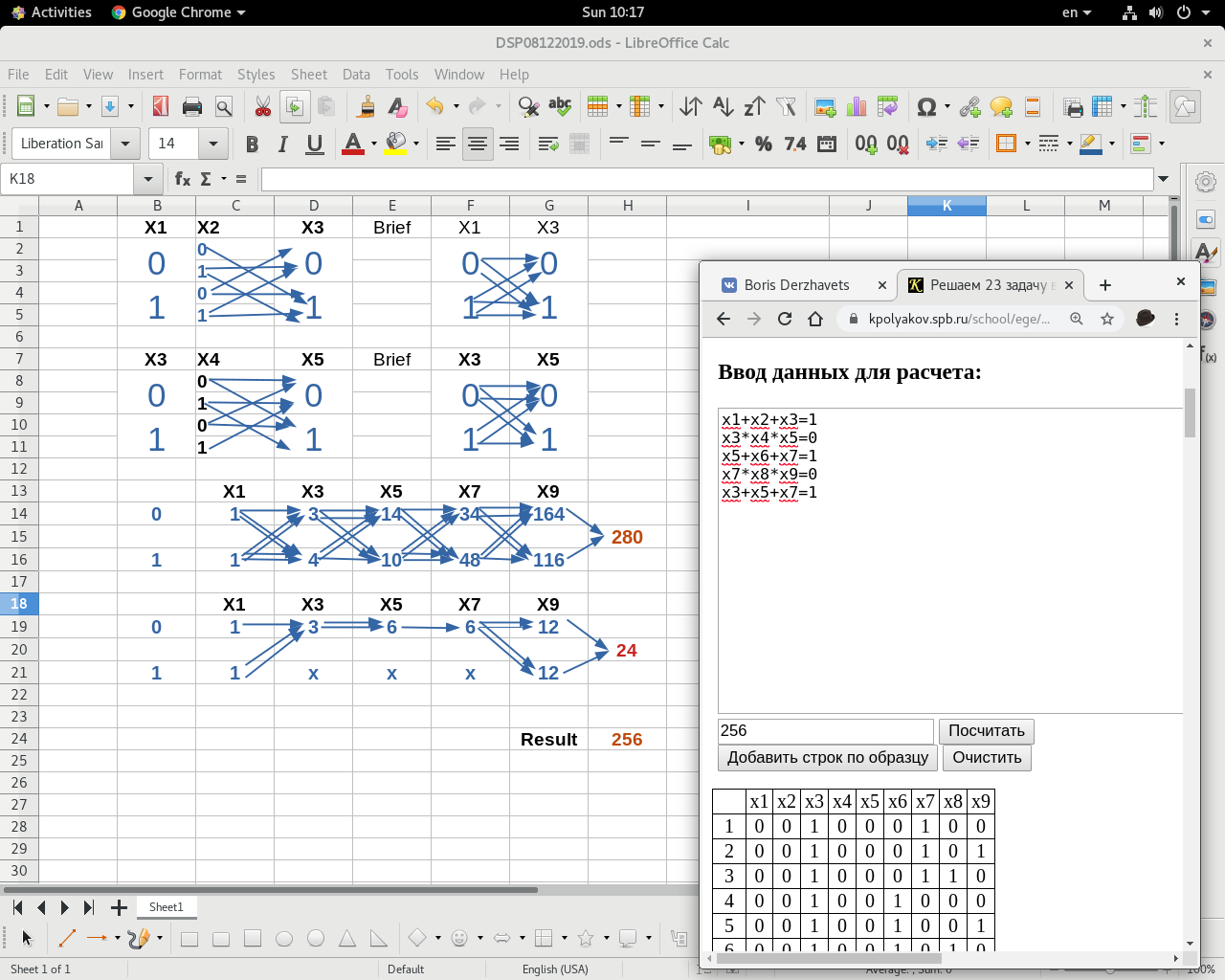
We solve the system obtaining the values ​​x3 and y4 by a counter passage to the center following the technique

https://vk.com/doc6125348_532065916?hash=35f707cd85ea4916b4&dl=cff7c616750b78af60

Demonstration of the effectiveness of the oncoming passage
using a simple example Yandex #T9302 USE Informatics


Решение Задания #T9302 Yandex Репетитор ЕГЭ Информатика 2020

Исходная система 


https://yandex.ru/tutor/subject/problem/?problem_id=T9302

Решим систему, получив значения х3 и у4 встречным проходом к центру и используем технику диаграмм  
https://vk.com/doc6125348_532065916?hash=35f707cd85ea4916b4&dl=cff7c616750b78af60

Демонстрация эффективности встречного прохода на простом примере Yandex #T9302 ЕГЭ Информатика


Sunday, December 29, 2019

Solution of Assignment #T6854 Yandex Tutor of the Unified State Examination Informatics 2020

Original task
See https://yandex.ru/tutor/subject/problem/?problem_id=T8654

 ¬(x1≡x2)∨¬(x3≡x4)∨¬(x5≡x6)=1
 ¬(x5≡x6)∨¬(x7≡x8)∨¬(x9≡x10)=1
 ¬(x9≡x10)∨¬(x11≡x12)∨¬(x13≡x14)=1
 ¬((x1∧x5)≡(x9∧x13))=1

Convert to equivalent system
 (x1⊕x2)∨(x3⊕x4)∨(x5⊕x6)=1
 (x5⊕x6)∨(x7⊕x8)∨(x9⊕x10)=1
 (x9⊕x10)∨(x11⊕x12)∨(x13⊕x14)=1
 (x1∧x5)⊕(x9∧x13)=1

Introduce variables z1,z2, . . , z7 as follows
  z1=x1⊕x2
  z2=x3⊕x4
  z3=x5⊕x6
  z4=x7⊕x8
  z5=x9⊕x10
  z6=x11⊕x12
  z7=x13⊕x14

Consider system (1)
   z1+z2+z3=1
   z3+z4+z5=1
   z5+z6+z7=1


Then, subtract the number of false solutions from the total number of solutions. The total number of solutions is obviously 89*2^7, each zj from the tuple {z1, z2, . , z7} which is a solution to system (1) implies a multiplication by 2
Proceed as follows
z1 = x1⊕x2
z3 = x5⊕x6
z5 = x9⊕x10
z7 = x13⊕x14
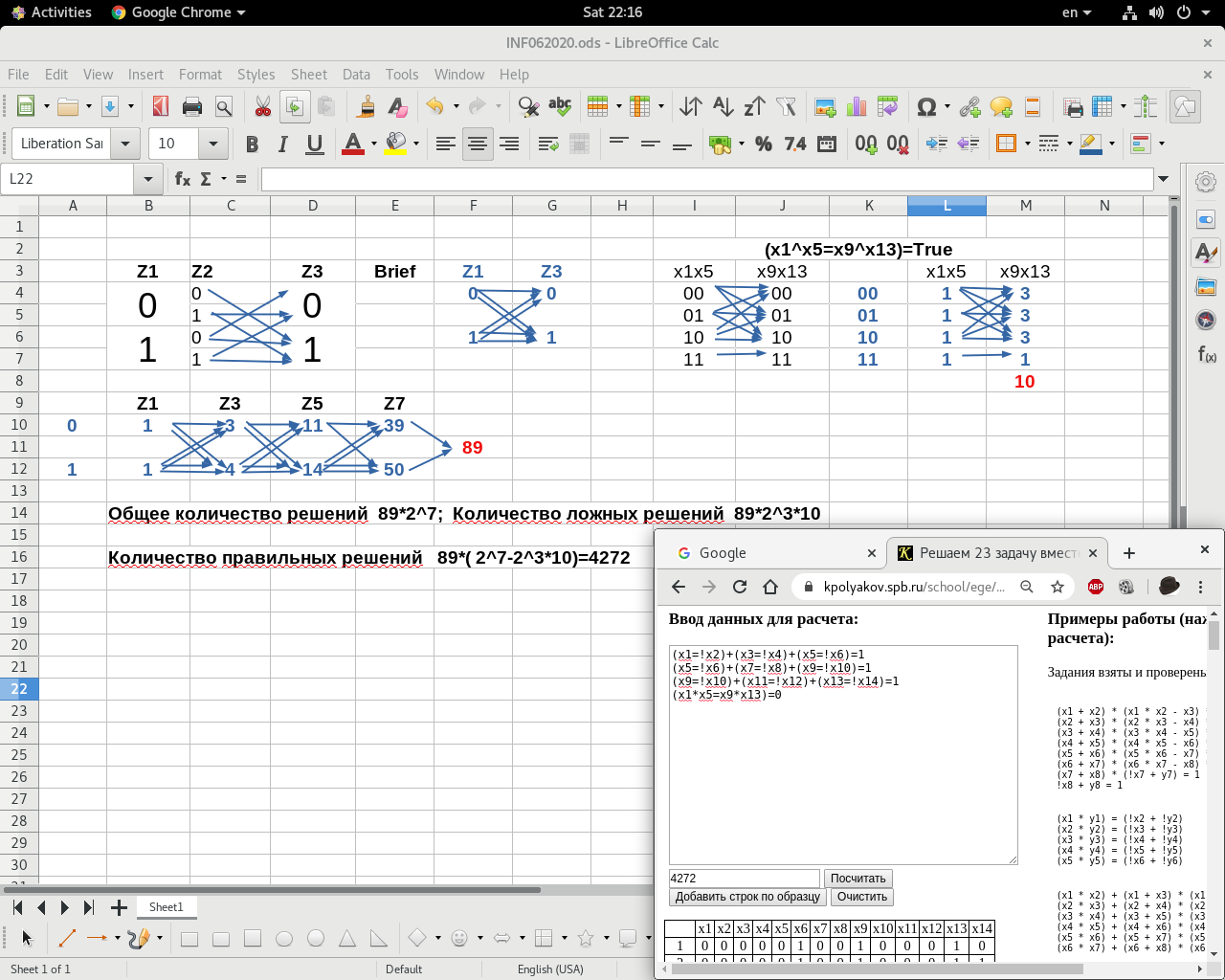
Thus, constructing the diagram {x1x5, x9x13} by assumption
(x1^x5=x9^x13) = 1 we get the number 10 by which we should multiply 2^3,
since z1,z3,z5,z7 give exactly 10 false options. Remaining z2,z4,z6 give 2*2*2 = 2^3 combinations. The total number of false solutions is 89*2^3*10.

Control for number of false solutions


  Control for number of total solutions  


   Finally double check obtained result


Saturday, December 28, 2019

Решение Задания #T6854 Yandex Репетитор ЕГЭ Информатика 2020

Исходная задача. 
Смотри  https://yandex.ru/tutor/subject/problem/?problem_id=T8654


¬(x1≡x2)∨¬(x3≡x4)∨¬(x5≡x6)=1
¬(x5≡x6)∨¬(x7≡x8)∨¬(x9≡x10)=1
¬(x9≡x10)∨¬(x11≡x12)∨¬(x13≡x14)=1
¬((x1∧x5)≡(x9∧x13))=1

Что равносильно

(x1⊕x2)∨(x3⊕x4)∨(x5⊕x6)=1
(x5⊕x6)∨(x7⊕x8)∨(x9⊕x10)=1
(x9⊕x10)∨(x11⊕x12)∨(x13⊕x14)=1
(x1∧x5)⊕(x9∧x13)=1

Введем переменные z1,z2, . . ,z7

z1=x1⊕x2
z2=x3⊕x4
z3=x5⊕x6
z4=x7⊕x8
z5=x9⊕x10
z6=x11⊕x12
z7=x13⊕x14

Рассмотрим систему (1)

z1+z2+z3=1
z3+z4+z5=1
z5+z6+z7=1


Затем из общего количества решений вычтем число ложных решений
Общее число решений есть очевидно 89*2^7, каждое zj из кортежа {z1,z2, . . ,z7} являющегося решением системы (1) влечет уможение на 2.
Далее
z1=x1⊕x2
z3=x5⊕x6
z5=x9⊕x10
z7=x13⊕x14
Таким образом, построив диаграмму {x1x5,x9x13} по условию
(x1^x5=x9^x13)=1 получаем число 10 на которое следует умножить 2^3, так как z1,z3,z5,z7 дают ровно 10 ложных вариантов.  Остаются z2,z4,z6, которые дают 2*2*2=2^3 комбинаций. 


   Вычитание из общего числа решений числа ложных решений   89*(2^7 - 2^3*10)=4272
   

Wednesday, December 25, 2019

Решение задачи 23 из традиционного Новогоднего КИМа от Алекса Данова

Условие


   Классика

   x1v(y1=>x2)^y2=0
   x2v(y2=>x3)^y3=0
   x3v(y3=>x4)^y4=0
   x4v(y4=>x5)^y5=0
   x5v(y5=>x6)^y6=0
   x6v(y6=>x7)^y7=0
   x7v(y7=>x8)^y8=0
   x8v(y8=>x9)^y9=0
   x9v(y9=>x10)^y10=0

   Для сравнения решим в стиле последней работы по системам уравнений в булевских переменных ( Метод Отображений - Видимая часть айсберга ИВШ №10 2019, Елена Мирончик ). Заметим , что x1,x2,...,x9 - это очевидные "0". Строим диаграмму для у1,y2,.. y9 согласно ¬y[j-1]^y[j] = 0,первые восемь долей одинаковые. х10 может быть любым, то есть переход у9 к у10 несколько сложней.


Tuesday, December 17, 2019

Setting up a cross-reference tables VERSUS Helen Mironchick's approach to solve "TASK 7" MAPPING METHOD - VISIBLE PART OF ICEBERG, Informatics at school #10 2019

The key place is a detailed description of building a cross-reference table 
when moving to a new line of the system. The chart generation is just a consequence.
First consider system

   (1) F1(x1,y1,z1)=>F2(x2,y2,z2) =1
   (2) F1(x2,y2,z2)=>F2(x3,y3,z3) =1
   (3) F1(x3,y3,z3)=>F2(x4,y4,z4) =1
   (4) F1(x4,y4,z4)=>F2(x5,y5,z5) =1
where F1 and F2 are triple predicates

Denote card(N) the power of set N
Denote n1,n2,m1,m2,s1,s2
    n1=card (falseSet_F2 ∩ falseSet_F1)
    n2=card (falseSet_F2 ∩ truthSet_F1)
    m1=card (truthSet_F2 ∩ falseSet_F1)
    m2=card (truthSet_F2 ∩ truthSet_F1)
    s1=card (falseSet_F1)
    s2=card (truthSet_F1)
See Setting up a cross-reference table in 08/2016 approach of Helen Mironchick when moving to a new line of the system of Boolean equations 
for more details 
Then following 08.2016 diagram would show

   Problem 7  itself in Helen Mironchick's "MAPPING METHOD - VISIBLE PART OF ICEBERG"  Informatics at school #10 2019


We intend to solve this system via cross-reference tables generation versus solution of the same system proposed in  "MAPPING METHOD - VISIBLE PART OF ICEBERG"
Just build the cross-reference table for system posted above following directions outlined in the very begining of current post, i.e analyzing four intersections  of  truth and false areas of predicates F1(X,Y,Z)=(X≡Y)≡Z and F2(X,Y,Z) = XvYvZ


   References ( VK active connection might be required )
  1.  https://vk.com/doc6125348_532065916?hash=35f707cd85ea4916b4&dl=cff7c616750b78af60

Saturday, December 7, 2019